
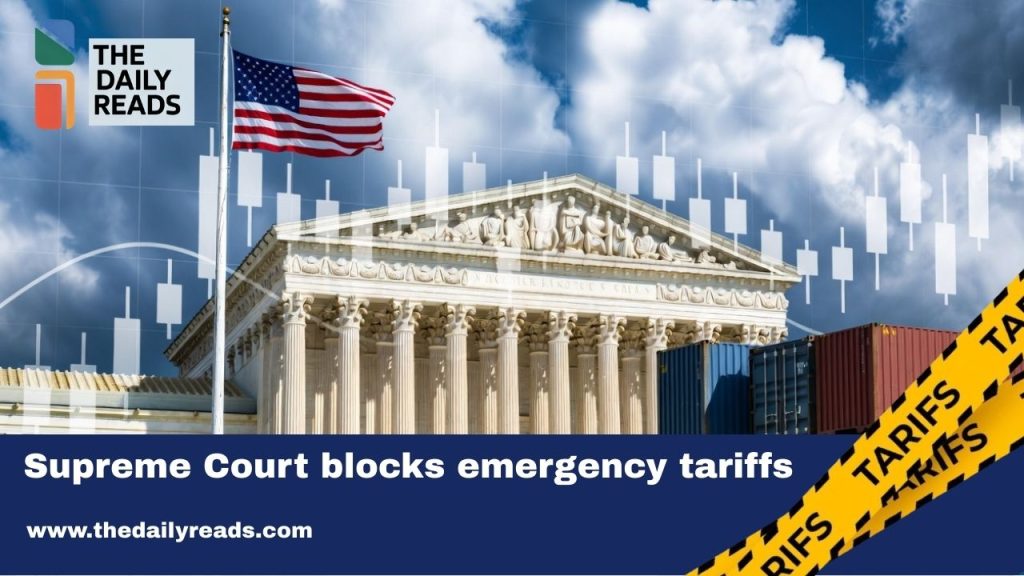
A landmark court ruling has struck down emergency-law tariffs, forcing customs officials to halt collections and raising thorny refund questions—while the White House scrambles to preserve leverage with a short-term import surcharge and threats of a higher rate. 1
Supreme Court Rules IEEPA Does Not Authorize Tariffs
For shipping managers and small importers, the past three days have felt less like a policy cycle and more like a lurching gear-change. On Friday, the U.S. Supreme Court issued a slip opinion addressing a central legal question—whether the International Emergency Economic Powers Act (IEEPA) authorizes the imposition of tariffs—and concluded that it does not.
That legal conclusion has immediate consequences far beyond Washington’s marble steps. In practical terms, it strips away the foundation for sweeping import duties imposed under the emergency law, and it compels the US customs system—where goods are priced, classified, and released minute-by-minute—to reprogramme in near real time. 2
Customs Halt Collections Under Emergency Law
The enforcement pivot is already written into operational language. In a bulletin to the trade community, U.S. Customs and Border Protection said it was issuing “guidance” tied to an Executive Order titled “Ending Certain Tariff Actions,” and that duties imposed under the emergency law “will no longer be in effect and will no longer be collected” for goods entered for consumption on or after 12:00 a.m. Eastern time on 24 February 2026. The broader implications of shifting U.S. trade policy are already visible in emerging markets, as discussed in our recent analysis of global economic trends shaping South Asia in 2026.
The same message lists the affected executive orders—including those tied to illicit drug flows, borders, and a broad “reciprocal tariff” effort—and notes that related tariff codes will be made inactive in the automated customs system. To the average shopper, that sounds abstract; to anyone trying to clear containers of parts, fabrics, or electronics, it reads as a hard deadline that changes the price of goods already on the water.
The administration’s answer has been speed. The White House has published a proclamation under section 122 of the Trade Act of 1974 framing the moment as a “fundamental international payments” problem and imposing, for 150 days, a temporary import surcharge of 10% ad valorem, effective 24 February at 12:01 a.m. Eastern time, with carve-outs for items deemed economically critical (including certain minerals, energy products, pharmaceuticals, some vehicles, and other categories). 3
Trump Signals Possible Increase to 15%

But the politics are moving even faster than the paperwork. In public comments reported by Reuters, Donald Trump said he would raise that global surcharge from 10% to 15%—the maximum rate allowed under section 122—after the court struck down the emergency-law approach. 4 Crucially, as of the latest text posted on the White House website, the operative proclamation language still states “10 percent ad valorem.” That gap—between an announced increase and the published legal instrument—has become the day’s core uncertainty for importers and their customers.
Overseas, trading partners are reacting to both the legal rebuke and the improvisation that followed. The European Commission has demanded “full clarity” from Washington and warned that unpredictable across-the-board tariffs disrupt transatlantic trade—pointedly invoking last year’s trade deal and the idea that “a deal is a deal.”
For businesses, the next question is money already paid. The Supreme Court decision itself does not lay out a refund mechanism, but the scale is no longer speculative. The Penn Wharton Budget Model projects that reversing the emergency-law tariffs could generate up to $175 billion in refunds, and that—unless replaced—future tariff revenue collections would fall sharply. 5 Businesses navigating tariff volatility can explore more updates in our Business news coverage section.
Behind those figures are human decisions: a small manufacturing firm delaying a payroll hire to cover unexpectedly higher landed costs; a family-run importer deciding whether to raise prices on children’s clothing; a logistics worker re-labelling entries at 2 a.m. to beat a tariff cut-off. Court rulings can look tidy on paper. In ports, they arrive as frantic phone calls and recalculated spreadsheets.
What This Means for Global Supply Chains
The US tariff system is now in a dual transition—out of emergency-law duties and into a time-limited surcharge whose final rate remains politically contested. Until the legal text and customs practice fully align, global supply chains will keep pricing in uncertainty as the real-world “policy” lands on invoices, not speeches.
Frequently Asked Questions About the US Tariff Ruling
Why did the Supreme Court block emergency tariffs?
The Supreme Court ruled that the International Emergency Economic Powers Act (IEEPA) does not authorize the President to impose tariffs, effectively ending duties imposed under emergency powers.
When did the emergency tariffs officially end?
According to U.S. Customs and Border Protection guidance, duties imposed under the emergency law stopped being collected for goods entered on or after 12:00 a.m. Eastern Time on 24 February 2026.
What is the new 10% import surcharge?
The White House issued a proclamation under Section 122 of the Trade Act of 1974 imposing a temporary 10% ad valorem import surcharge for up to 150 days.
Could the tariff rate increase to 15%?
Donald Trump publicly stated that the surcharge could rise to 15%, the maximum allowed under Section 122. However, the official proclamation currently specifies a 10% rate.
Sources
- 24-1287 Learning Resources, Inc. v. Trump (02/20/2026) ↩︎
- CSMS # 67834313 – Ending Collection of International Emergency Economic Powers Act Duties ↩︎
- Imposing a Temporary Import Surcharge to Address Fundamental International Payments Problems ↩︎
- After court ruling, Trump says US global tariff rate will rise from 10% to 15% ↩︎
- Supreme Court Tariff Ruling: IEEPA Revenue and Potential Refunds ↩︎
Learn more about our editorial standards on our About Us page

MS Shawn (Md. Shakil Shawn) is a Bangladeshi news writer and political analyst specializing in politics and business reporting. He focuses on delivering fact-based, research-driven news that explains complex political and economic issues in a clear and accessible way. His work aims to promote informed discussion and responsible journalism in the digital media space.