
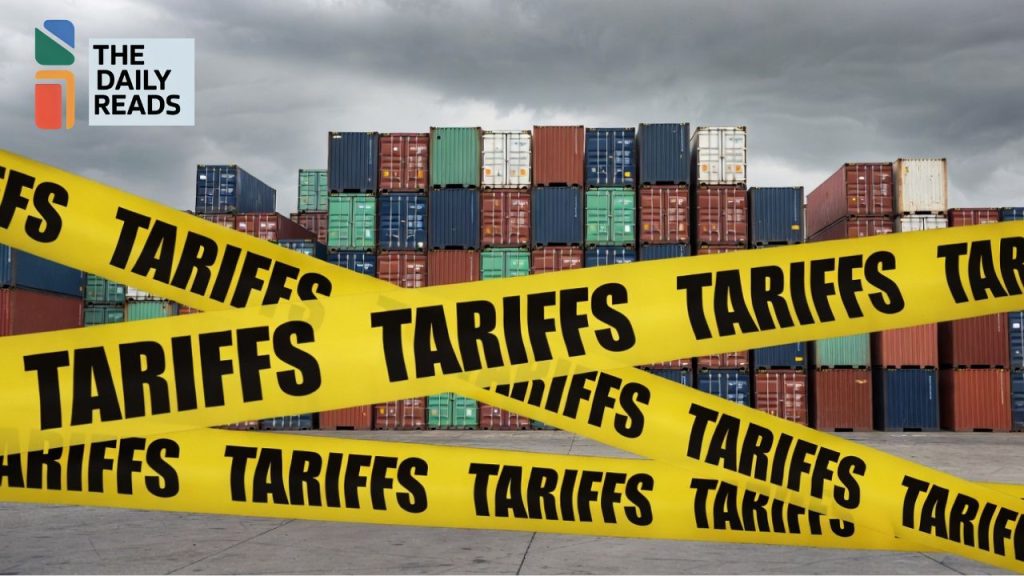
South Asia’s 2026 outlook is being shaped by three global forces: tariff volatility, slowing trade, and shifting financial conditions. Forecasts from major institutions still point to solid regional growth, but they also warn that policy uncertainty—especially around tariffs—can hit exports, investment planning, and currencies quickly.
At the same time, a softer commodity price outlook—particularly for oil—could ease import bills for energy‑importing economies, helping inflation cool and giving policymakers more room.
The result is a more “two‑speed” year: some economies have space to support growth, while others remain constrained by higher inflation and financing needs. The Daily Reads continues to monitor global economic developments.
Global trends shaping South Asia in 2026
Growth is steady, but trade is softer
Major forecasters see no global slump, but they do see slower momentum in trade—key for South Asian exporters. The International Monetary Fund projects global growth of 3.3% in 2026, with world trade volume growth slowing to 2.6% and inflation easing further.1 The World Bank forecasts global growth of 2.6% in 2026 and explicitly expects a 2025 trade “front‑loading” boost to fade in 2026.2 The OECD also expects moderate global growth in 2026.
For the region, the World Bank projects South Asia’s growth to moderate to 6.2% in 2026, linking the slowdown to increased trade restrictions.3 The Asian Development Bank puts South Asia’s 2026 growth at about 6.0% in its latest outlook summary. 4
Tariffs and supply chains are the headline risk
The bigger story in 2026 is not “trade weakness” in the abstract—it is rule uncertainty. A tariff swing can change costs overnight, forcing exporters to re‑price contracts and buyers to reshuffle orders.
A February 22 report by Reuters said India delayed planned trade talks after the US Supreme Court struck down parts of a tariff regime, followed by a move to impose a temporary 15% tariff cap on imports.5 The Financial Times has also reported on the same tariff episode and the uncertainty that followed.
For South Asia, this lands in three places quickly:
- Merchandise exports (e.g., apparel, light manufacturing) face weaker order visibility when policy rules shift.
- Investment decisions get delayed: factories and long contracts are harder to justify in a volatile tariff setting.
- Services can be more resilient, but buyers still renegotiate and shorten commitments in uncertain years.
For more updates, visit our Business section.
Energy prices and inflation decide policy room
Energy and food costs determine how much room governments and central banks have. The World Bank’s January 2026 “Global Monthly” summary projects commodity prices to fall about 7% in 2026, and expects Brent crude to average about $60 per barrel in 2026. That is a potential relief for oil‑importing South Asian economies.
But inflation inside the region is uneven in early 2026:
- India: January CPI inflation 2.75% (new base series).
- Bangladesh: January inflation 8.58% (BBS data reported in local coverage).
- Sri Lanka: January headline inflation 2.3% (CCPI).
- Pakistan: January CPI inflation 5.8%.
This split matters: low inflation supports rate cuts and credit growth; high inflation keeps policy tight and slows household spending.
Capital flows and debt still matter
Even if global rates drift down, financing can tighten fast if trade shocks push inflation back up. The OECD projected the policy rate in the United States could decline further, reaching about 3.25–3.5% by end‑2026 (projection as of December 2025).
The World Bank also notes that easier financial conditions helped in late 2025, but warns that sudden market moves remain a risk—especially if policy uncertainty rises again.
What it means for South Asia’s biggest economies
India: Domestic demand and services give resilience, but export outcomes can swing with tariff decisions and trade negotiations. India’s CPI base revision also reshapes inflation comparisons throughout 2026.
Bangladesh: Inflation remains elevated, which squeezes households and complicates faster easing. Export industries also face buyer pressure in a slower-trade, tariff‑volatile world.
Sri Lanka: Low inflation improves policy room, but the recovery still hinges on reforms, tourism momentum and financing conditions.
Pakistan: Inflation is lower than past peaks but still central to stability; external financing conditions remain a key constraint.
Smaller economies such as Nepal, Bhutan and Maldives remain more exposed to tourism cycles, fuel costs and climate shocks; a softer oil outlook helps, but one shock can dominate a year.
A useful framing comes from The Guardian: 2026 is shaped by cooling inflation and AI optimism on one side, and trade-policy uncertainty on the other.
Sources
- World Economic Outlook Update, January 2026 ↩︎
- Global Economy Shows Resilience Amid Historic Trade, Policy Uncertainty ↩︎
- Global Economy is Resilient, but Vulnerable Countries Lag ↩︎
- OECD Economic Outlook, Volume 2025 Issue 2 ↩︎
- India delays U.S. trade talks after Supreme Court rejects Trump tariffs, source says ↩︎
Learn more about our editorial standards on our About Us page

Md. Ahasan Habib Rifat, born 2 October 2006 in Rangpur, Bangladesh, is a Bangladeshi author known for his works on Islam, comparative religion, and themes promoting peace and compassion. He is the founder of Islampidia, a platform for authentic Islamic knowledge in Bengali, and Khagrabondo Adorsho Bidya Niketon, a primary school promoting quality education and ethical values.
Rifat completed his primary and secondary education at Maddhapara Granite Mine School from 2016 to 2022 and higher secondary studies at Border Guard Public School & College, Rangpur from 2023 to 2024.