AI Data Centers Are Driving Up Electricity Demand: Who Pays the Real Price?
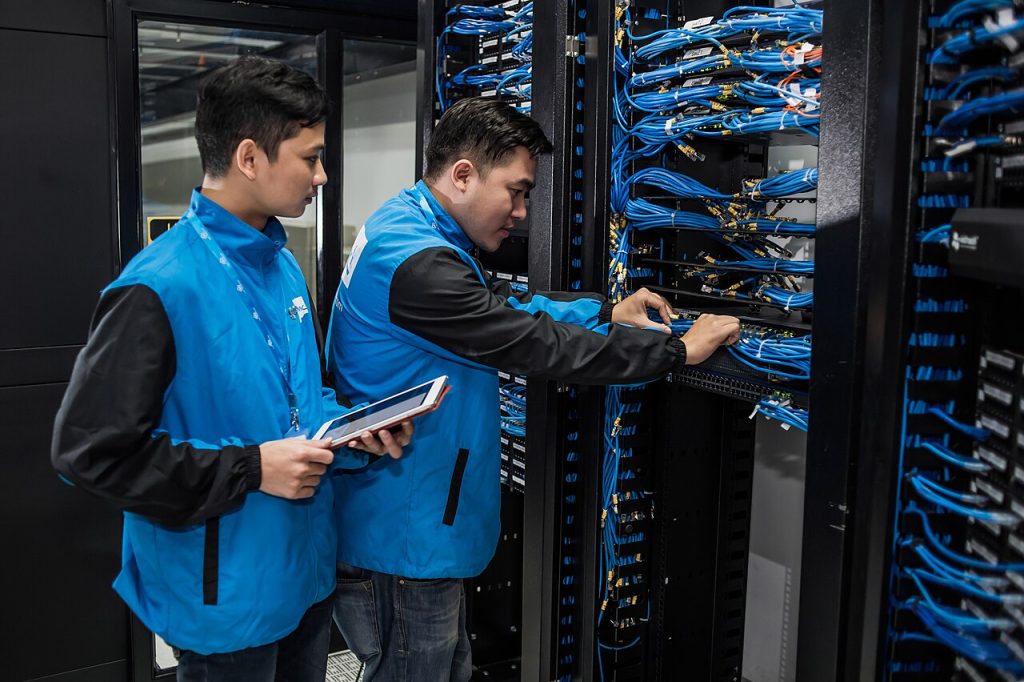
CMC Telecom, Data Center của CMC Telecom By Daoducquan, via Wikimedia Commons.
America’s race to build artificial intelligence isn’t just happening in labs and boardrooms anymore. It’s happening in concrete and copper, in cooling pipes, transmission lines and power plants, and a lot of it is going up next to neighborhoods that never asked for it.
Data centers are the physical backbone of the AI economy. They hold the servers that train and run chatbots, image generators, coding assistants and industrial software. They also use huge amounts of electricity, drink water for cooling, put pressure on local grids and can change what people pay on their utility bills. So here’s the plain question: as Big Tech builds out its computing empire, who ends up footing the bill?
A sudden jump in demand
For years, US electricity demand barely moved. Better appliances, LED bulbs, shifts in industry and a flat population kept things steady. That’s over.
The Energy Information Administration expects electricity use to grow 1% in 2026 and 3% in 2027. That would be the first four straight years of growth since 2007, and the strongest four-year stretch since 2000. The agency points to large computing centers as a main reason.
It’s easy to underestimate the scale. In 2023, US data centers used about 176 terawatt-hours of electricity, around 4.4% of the country’s total, according to Lawrence Berkeley National Laboratory. That’s more than many whole countries use in a year.
The curve is steep. Berkeley Lab found data-center use climbed from 58 TWh in 2014 to 176 TWh in 2023, and projected 325 to 580 TWh by 2028. Its 2025 update put 2024 usage at 192 TWh, or 4.7% of the national total, and suggested data centers could reach 11.8% by 2030.1
Those are projections, and they could miss. Much depends on how fast AI spreads, how efficient new chips and cooling get, and whether developers can actually get land, permits, transformers, turbines and grid connections. Even the low-end scenarios would still be a historic change.
Why AI Uses So Much Electricity
Any data center needs round-the-clock electricity for servers, networking, storage, lighting and cooling. AI makes it worse because modern machine learning runs on specialized chips, mostly GPUs, that draw far more power than ordinary servers.
Training a large model can take weeks or months of heavy computing. Once it’s released, running it (called inference) can add up to even more energy overall, since millions of people use it all day long. Berkeley Lab says data-center power demand more than doubled between 2017 and 2023, largely because of AI servers.
The International Energy Agency expects global data-center electricity demand to roughly double, from 485 TWh in 2025 to 950 TWh in 2030, with AI-focused facilities tripling over that time. In the US, it says data centers will account for almost half of demand growth between now and 2030. By then, the country will likely use more electricity to process data than to make all its energy-intensive goods put together, including aluminum, steel, cement and chemicals.
That doesn’t mean every chatbot question burns through a household’s daily power. Efficiency gains are real, and companies are putting money into better chips, liquid cooling and leaner software. But total demand keeps rising anyway. When usage grows fast enough, even big per-unit savings get swamped by the number of new buildings and workloads.
The bill lands somewhere
For most Americans, the worry isn’t a national statistic. It’s the monthly electric bill.
A big data center can’t just plug into the wall. It may need new substations, high-voltage lines, local upgrades and sometimes new power plants. That costs billions, and the fight is over who pays: the companies creating the demand, all utility customers, or some mix.
Consumer and environmental groups say utilities have traditionally spread infrastructure costs across homes and businesses alike. If a data center triggers a new transmission line or forces a utility to buy more generation, they argue, ordinary households end up subsidizing equipment built mostly for a few corporate customers.
An analysis cited by NPR estimated that in 2024, homes and businesses in Illinois, Maryland, New Jersey, Ohio, Pennsylvania, Virginia and West Virginia faced about $4.3 billion in extra costs from transmission projects needed to serve data centers. That comes from an advocacy analysis, not a full national accounting, but it shows why people are nervous.
There’s another side. Utilities and some economists say large customers can spread fixed grid costs over more users, boost local tax bases and pay a lot for their power. The real issue isn’t whether data centers use electricity. It’s whether rates assign the cost of new generation, transmission and reliability to the customers who cause it.
Some regulators are stepping in. In July 2025, Ohio regulators approved a plan requiring new data centers to pay for at least 85% of the energy they sign up for each month, even if they use less. The goal is to keep residents from covering the cost of capacity reserved for data-center growth. Expect other states to look at it closely. Should a household in Columbus, Phoenix or Northern Virginia pay more because a tech company wants a giant campus down the road?
Water turns local
Electricity is only half of it. Data centers throw off heat, and keeping thousands of powerful chips from overheating takes cooling, whether that’s evaporative towers, chillers or liquid systems.
The Congressional Research Service, citing the IEA, says a 100-megawatt US data center can directly use about as much water each day as 2,600 households. US data centers directly used roughly 17 billion gallons in 2023, up from 5.6 billion in 2014. None of that counts the water used indirectly to generate electricity, which can be a lot when the power comes from thermoelectric plants.
National totals can sound manageable. Local impacts often don’t. Water is a town’s supply, a farm’s irrigation, an aquifer or a river. A facility drawing millions of gallons a day can matter enormously in a drought-prone place even if it’s a sliver of national use.
In The Dalles, Oregon, reporting on Google’s water use has raised questions about transparency and local supply. One account cited by the University of Colorado’s Getches-Wilkinson Center said Google’s data centers there used about 550 million gallons in 2025, close to 40% of the city’s total consumptive use for the year.
In Arizona, where long-term drought and Colorado River shortages already make water a political fight, opposition has been intense. Tucson’s city council turned down an Amazon-linked project, Project Blue, in August 2025 over fears it would become a major water customer.
Industry says data centers can use recycled water, treated wastewater, air cooling or closed-loop systems, and that some use far less than others. All true. But every choice has a catch: air cooling tends to use more electricity, while water cooling saves power and raises local water demand. The right answer depends on the climate, the water supply and the power mix.
The deeper problem is secrecy. Companies often treat site-level water use as proprietary, and utilities may not release customer data. So communities often hear about a proposed withdrawal after the project is well along, when they have little leverage left.
Data centers do bring investment: construction jobs, property taxes, utility payments and sometimes permanent technical work. Local officials compete hard for them with tax breaks, land, water access and fast permits.
But the benefits aren’t evenly shared. Construction ends. Permanent staffing is often small because these buildings are so heavily automated. Meanwhile neighbors deal with truck traffic, noise from cooling equipment and backup generators, changed landscapes and the chance of higher bills.
In Northern Virginia, home to one of the densest clusters of hyperscale data centers anywhere, residents describe constant noise and a feeling that heavy industry has moved into their suburbs. In Georgia, some people have raised concerns about their drinking-water wells after nearby construction.
Pushback is growing. Data Center Watch counted at least 142 activist groups in 24 states organizing against data-center projects between May 2024 and March 2025, and estimated $64 billion in projects were blocked or delayed. The group is advocacy-oriented, so treat that as a sign of organized resistance, not a full measure of local opinion.
It isn’t really progress versus opposition. It’s a fight over who decides how scarce resources get used. A data center can create value nationwide through cloud services and AI products while its water, noise, land and grid effects stay stubbornly local.
Nuclear makes a comeback
With demand climbing, tech companies are turning to nuclear. The pitch is simple: reactors produce big amounts of power around the clock with no direct carbon emissions, which suits companies chasing AI growth and climate goals at once.
In September 2024, Microsoft signed a 20-year deal with Constellation Energy to help restart Three Mile Island Unit 1 in Pennsylvania, an 837-megawatt reactor idle since 2019. Constellation later said it expected to be running again in 2027. Amazon Web Services signed a 10-year agreement with Talen Energy in March 2024 for power from the Susquehanna plant, also in Pennsylvania. Google agreed with Kairos Power to develop 500 megawatts of small modular reactors near its data centers, starting around 2030. Meta followed in June 2025 with its own 20-year deal with Constellation.2
Deals like these could help fund the first real expansion of US nuclear capacity in decades, and they might cut the need for new fossil generation in the regions involved.
Still, nuclear won’t fix things quickly. New reactors take years to license, finance, build and connect. Restarts move faster but still need regulatory review, trained workers, fuel and transmission access. Small modular reactors look good on paper, but most haven’t been deployed commercially in the US.
There’s a fairness question too. Does a long-term nuclear contract actually add clean supply, or does it just pull existing low-carbon power away from other users? It depends. A reactor restarted after closing adds supply. A contract with a plant that was running anyway may help pay its bills, but it doesn’t create new electricity.
Why Is the Power Grid Struggling to Keep Up?
The US doesn’t really have an AI electricity problem. It has a timing problem. A data center can go up in a few years. Transmission lines, substations, gas turbines, wind and solar farms, batteries and nuclear plants usually take much longer.
That gap carries real risks. Utilities may lean on existing fossil plants for longer, which means more emissions and local air pollution. Long interconnection queues can hold up new clean generation just when it’s needed. Transmission limits can drive up costs and make reliability harder. And utilities might make irreversible investments based on shaky forecasts of AI demand.
EIA’s long-range modeling shows how uncertain this is. Its Annual Energy Outlook 2026 includes a high-demand case where data-center server energy use alone hits 818 billion kilowatt-hours by 2050, assuming exponential growth in AI-server capacity through at least 2040 and only partial efficiency gains.3
The grid won’t collapse overnight because of AI. But it could get more expensive, dirtier and more politically messy if demand outruns the clean power and transmission needed to serve it.
What a fair deal could look like
The AI boom doesn’t have to mean corporate profits propped up by ordinary ratepayers and strained water systems. Avoiding that takes deliberate policy.
States and utilities can make large data-center customers pay the full, traceable cost of the generation and transmission they cause. They can require honest projections of electricity and water use before approving permits, and make companies report actual water consumption, use recycled or non-potable water where they can, and help pay for local infrastructure.
Local governments can push for stronger community-benefit agreements: protection for wells and watersheds, noise limits, local hiring, tax deals that don’t gut public revenue, and enforceable rules on backup generators.
Federal policymakers can speed up interconnection for new clean power, modernize transmission planning, and back advanced nuclear and long-duration storage, without treating every corporate power deal as proof the grid problem is solved.
And the companies can do more than announce sustainability pledges. They can build where water and grid capacity actually exist, disclose site-level impacts, buy new clean generation instead of just claiming existing supply, and accept rates that make them accountable for what they need.
The choice ahead
AI may turn out to be one of the most important technologies of the century. It could speed up medical research, make businesses more productive and create whole new industries. None of that erases its physical costs.
Right now America is deciding, project by project and rate case by rate case, whether this boom will be paid for by everyone, through higher bills, drained aquifers, delayed clean-energy projects and neighbors living beside industrial sites, or by a more honest system where the companies driving demand cover more of what it costs.
The technology is new. The question is old: when a powerful industry builds something enormous, who gets the benefit, and who gets the bill? The answer will decide whether America’s AI future is not just fast, but fair.
Common Questions About AI Data Centers
Why do AI data centers use so much electricity?
Any data center needs round-the-clock power for servers, networking, storage, lighting and cooling. AI makes it worse because modern machine learning runs on specialized chips, mostly GPUs, that draw far more power than ordinary servers.
How much electricity do US data centers use?
According to Lawrence Berkeley National Laboratory, US data centers used about 176 terawatt-hours in 2023, around 4.4% of the country’s total electricity. In 2024 that rose to 192 TWh, or 4.7%.
How fast is data-center electricity use growing?
Quickly. Berkeley Lab found it climbed from 58 TWh in 2014 to 176 TWh in 2023, and that demand more than doubled between 2017 and 2023, largely because of AI servers.
What are the projections for 2028 and 2030?
Berkeley Lab projects 325 to 580 TWh by 2028, and says data centers could account for 11.8% of national electricity use by 2030.
Are those projections guaranteed?
No. They depend on how fast AI spreads, how efficient new chips and cooling become, and whether developers can actually get land, permits, transformers, turbines and grid connections. Even the low-end scenarios would still be a historic change.
What does the EIA expect for overall US electricity demand?
The Energy Information Administration expects use to grow 1% in 2026 and 3% in 2027. That would be the first four straight years of growth since 2007 and the strongest four-year stretch since 2000, with large computing centers named as a main driver.
How much will global data-center demand grow?
The International Energy Agency expects it to roughly double, from 485 TWh in 2025 to 950 TWh in 2030. AI-focused data centers are expected to triple over that period.
How much of US demand growth will come from data centers?
The IEA says almost half of US electricity demand growth between now and 2030 will come from data centers.
Will data centers use more power than heavy industry?
By 2030, the IEA says the US will likely use more electricity to process data than to make all its energy-intensive goods combined, including aluminum, steel, cement and chemicals.
What is Ohio’s 85% rule?
In July 2025, Ohio regulators approved a plan requiring new data centers to pay for at least 85% of the energy they sign up for each month, even if they use less. It is meant to keep residents from covering the cost of capacity reserved for data-center growth.
References
- Berkeley Lab Report Evaluates Increase in Electricity Demand from Data Centers – Berkeley Lab – Berkeley Lab News Center ↩︎
- Annual Energy Outlook 2026 ↩︎
- AI is set to drive surging electricity demand from data centres while offering the potential to transform how the energy sector works – IEA ↩︎
About The Author